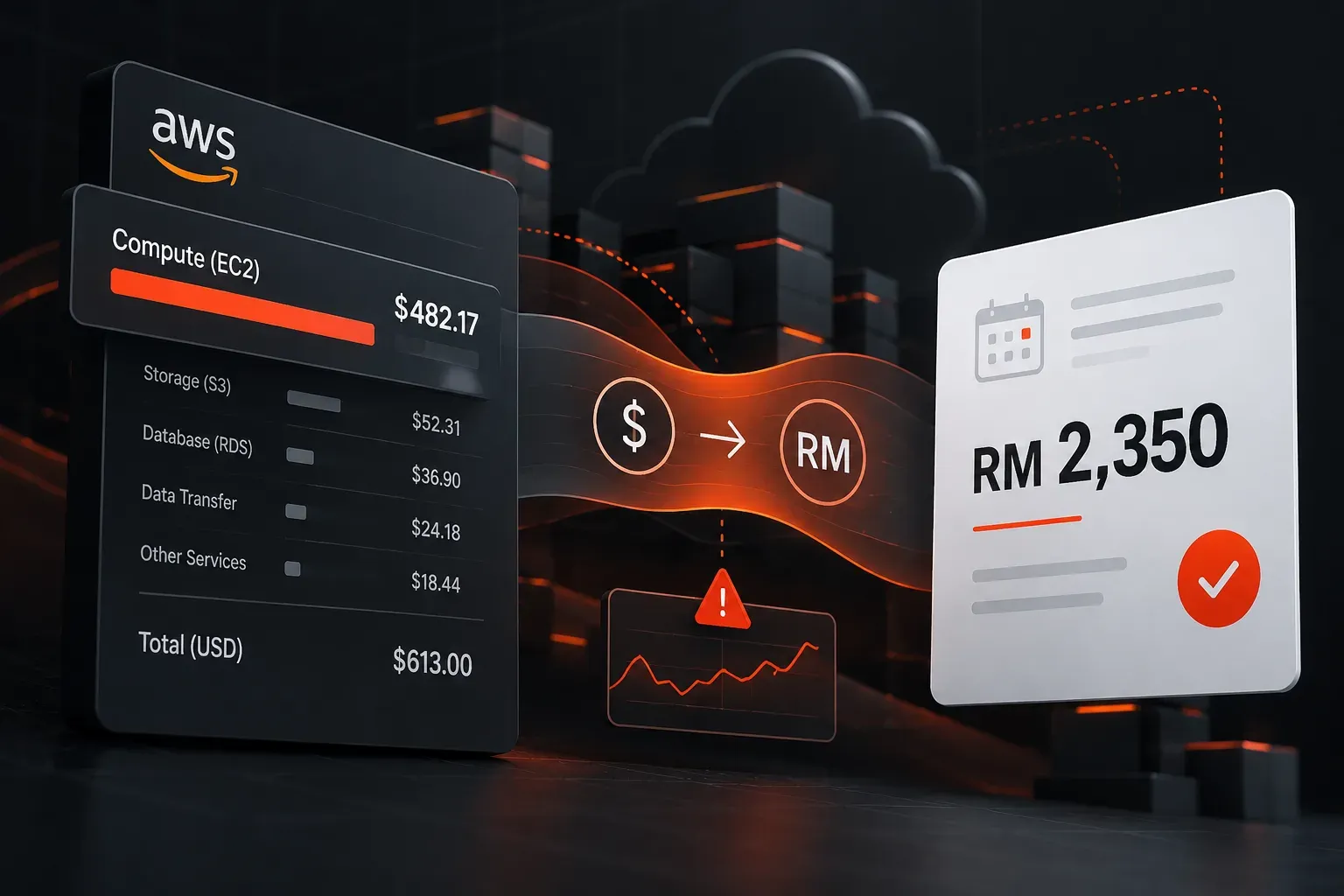
A client needs a cloud account renewed and wants to know what it costs. Not a calculator screenshot. One number, per month, in ringgit, firm enough to put in front of a finance department.
AWS does not work that way. It bills in US dollars, by the hour, against consumption nobody knows in advance. Most of the work in quoting one is deciding, deliberately, who carries each of those risks.
The currency has to be a position, not a guess
You cannot quote a ringgit figure against a dollar bill without picking a rate, and picking a rate means picking a date. Whatever you choose is wrong by the second month.
The answer is not a better forecast. It is a stated rate with a buffer over the mid-market figure, written into the assumptions where the client can see it, plus a movement threshold that triggers a price review rather than a silent absorption. A few percent of drift is noise and should be eaten. A large move is a different commercial deal, and pretending otherwise just means one party quietly loses money all year.
The buffer is not margin. It is the cost of holding the currency risk instead of handing it back to the client every month.
Reserved capacity is a decision about the client
Reserved Instances are cheaper. They are also a one or three year commitment, and they lock in an instance shape before anyone has watched a full year of real usage.
Where the workload is still being understood, the right answer is On-Demand with no upfront commitment, and to say so in writing. The saving is real, but it is bought with flexibility the client should keep for now. A quote that takes the discount without asking has made a multi-year decision on someone else’s behalf. Once there is a year of real consumption behind it, that conversation is worth reopening, and by then it can be had with evidence.
One line item usually is the bill
On a recent account, the managed SQL Server database was around two thirds of the entire monthly cost. Not the compute, not the storage, not the transfer. One database instance.
That is what “License Included” pricing means. The Microsoft licence is bundled into the hourly rate, so you rent it again every hour the instance runs, forever. Bringing your own licence is an option, and it is the client’s call because it depends on agreements we cannot see. But it only gets considered if someone points at the line and says plainly that this is where the money goes.
Most cloud cost conversations start with instance sizing. On a Windows workload, sizing is usually the smaller half of the problem.
Fixed and estimated have to be separated
Some quantities are known: the instances, the allocated storage, the fixed services. Others are genuinely usage dependent, and any number written next to them is an estimate wearing a straight face.
So the baseline splits into the two, explicitly. Anything above the estimated line bills at cost plus the same margin, against a usage report the client can read. Nobody has to be right about the future for the arrangement to stay fair.
Exclusions are part of the number
Migration, support plans, domain registration, NAT Gateway, key management, overage transfer. All named, all out.
An exclusions list is not defensive. It is the only honest way to say what the monthly figure covers, and it is far cheaper to write into a quote than to discover in month four.
The quote is the easy half
A cloud account that nobody is watching drifts. Instances get resized and never resized back, storage grows, a test environment stays running for a year. The bill goes up and the first anyone hears of it is the renewal.
That is the part we do on a Care Plan: the account and the servers on it stay looked after, patched, backed up and monitored, with the usage actually read each month rather than filed. We do the sizing, quoting and buildout as project work across AWS, Alibaba Cloud, DigitalOcean, OVHcloud and Hetzner, and most clients stay on for the running of it afterwards.
If you have a cloud renewal coming and no clear sense of whether the number is right, get in touch with what you are running now.